


– optimal for the lowest long-term investment. So automatically searching for the optimal voltage loss.
– optimal for the lowest procurement. The lowest possible cross-section but still just on the edge of sufficient.
– Saving and printing so that it is easy to find out in the project files on what basis the calculations were made.
– All settings and results clearly displayed on one screen.
Suitable for Windows 11.
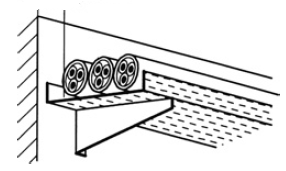
The basis of the program is to determine the thermal load on the cable for the specified cable configuration and cable laying method via the tables in the IEC 60364 (BS 7671/NEN 1010/AREI/VDE 0100), the voltage loss in the cable and the short circuit length. The short-circuit length depends, among other things, on the selected fuse or circuit breaker, and for instance whether the cable is a shielded version.
The motor shaft power(kW) or design current is specified by the user as the input for the cable calculation.
The cable cross section ranges from 0.25 mm² to 2500 mm², allthough AWG sizes are also available.
If a motor has been selected for the load type, the program selects a standard motor and calculates its efficiency and considers the starting current related to the starting method (direct, soft starter, frequency converter), and determines the size of the fuse or circuit breaker.
Because all data is included in a single screen, you can play with the parameters and look for the most favorable cable possible. By ‘playing around’ a cheaper cable can almost always be found!
Of course, the calculated values are printed in an extensive presentation:
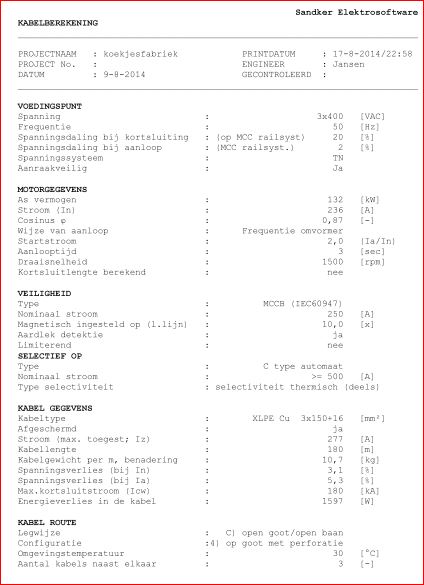
The KABEL++ program is richly provided with extensive help texts which can be opened via the F1 key, but also in the form of so-called hints that appear when the user rests the mouse on an input field for a few seconds. In this way the user is guided to the best choice of cable for price and tax. A lot of attention has been paid to these help texts.
If a single cable cannot be selected (>240 mm²), cables in parallel are automatically selected.
Large cross sections:
The largest cross-section is default set to 240 mm², however, a maximum cross-section up to 2500 mm² can be selected. The minimum cross-section is 0.25 mm².
The program comes with a large number of characteristics of fuses and circuit breakers:
– manufacturers such as ABB, Schneider, Siemens, Eaton, Hager, as well as
– norm characteristics such as the B, C, D and the K characteristic,
– norm characteristics like gG, gL and aM fuse,
– fuse manufacturers such as Siba, Eaton or Siemens,
– and electronic trip.
The user can expand this himself. A number of special protections are also included.
– For example, Pro-tec has been included for public lighting,
– and a differential protection is included to protect a generator cable (including the Selco-T2900 or the Woodward MRD)
– The inverse thermal characteristics in accordance with IEC 60255-3 are included for transformers, among others,
– and for motors the NEMA thermal trip characteristics.
The program can handle 1 phase of 3 phase heavy current as well as direct current at all possible supply voltages.
Various cable types are included, mainly constructed from copper and aluminum for the conductors and XLPE, PVC, EPR and rubber for insulation. Standardized codes based on these material types are: HO7, HO5, HD604, N2XH-O/J, N2X,
NY, YmvK, YmvKas, VmvK, XmvK, and rubber types such as HO&RN, HO7BQ, NSSHOU, RmcLz and MPRX for use on ships. Such cables are manufactured by a cable factory such as Draka, TKF, v ’t Hof, Nexans, Topcable.
Belgian varieties such as XVB are also present.
Naturally, the (high-voltage) medium-voltage cables are also included (HD 620).
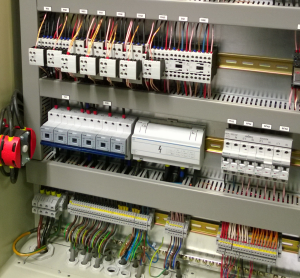
Which is often the closing item, determining the cross-sectional area of cabinet wiring for each descending group. Kabel++ also presents in each printout of the calculation result, the cross-section of the cabinet wiring for the respective descending group. The cross-section of cabinet wiring or mounting wire is then calculated for both loose wiring and for wiring which lies in a tray.
Cables feeding fluorescent lighting, especially for assimilation, face additional heating of the cable due to the higher harmonics caused by this lighting.
A cable to a charging station for electric cars will in most cases be laid out for 3.7 kW 1 phase and as 11 kW with a 3 phase cable. In Kabel++ you calculate this cable in a simple way. Settings are preferably a circuit breaker type B and voltage loss 3% so that there is still room for voltage loss across the charging cable.
But high capacity charges such as 150 kW direct DC charge are no problem for Kabel++
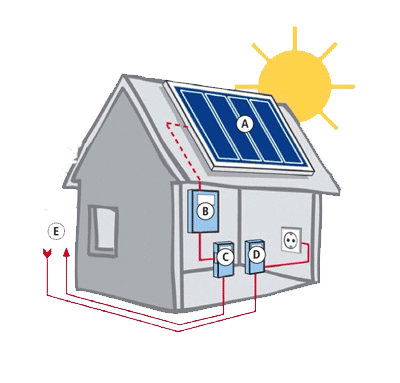
Kabel++ is equipped with a wizard to easily let the program do the settings for PV systems by itself,
on which, after taking into account the efficiency of the inverter, the influence of the actual power versus the peak power of the panels, the cable is calculated. The wizard also asks you whether the cabling in the PV system is before or after the inverter.
Since solar panels cannot supply short-circuit current, the short-circuit current calculation is done specifically.
A special module is added to calculate a PV array in terms of cross-sectional area, the Impp, Isc and Umpp. The reverse current, or allowable return current is also evaluated. Also calculated is whether overvoltage protection should be applied (IEC 62305-2).

Optimal cable cross section versus energy loss in cable length.
The thicker the cable the lower the voltage loss and thus less energy loss due to design current. However, a larger cable cross section comes at the cost of a higher investment. So a balance must be struck here.
A cable is not continuously loaded, but for example only 4 hours a day at 50% of the load and 1 hour at 80% of the design load. So a good ECO recommendation cannot be made solely from the cable price and voltage loss. To this end, Kabel++ has an EMV (economically most advantageous) calculation to search for the optimal situation.
With respect to the current trend toward sustainable green energy -sustainability and CO2 savings- this option is highly recommended.
We want to do more about a sustainable earth. The cross-section of a sustainable cable is no longer determined by the most economical, (energy loss in the cable over its lifetime versus the purchase cost of a cable), but by the CO2 load or recyclability. In Cable++, an LCA calculation has therefore been added that calculates the CO2 load from manufacture to end use. Based on this data, the Eco module can now be used to determine the optimal cable cross section from the CO2 load versus cross section.
The short circuit current is asymmetric and large immediately after the short circuit. Through subtransient value, the short circuit current drops to the static value. In addition, it matters whether the short circuit is between phases, between phase and ground, whether or not it is a smaller ground wire than the phase wire. Also to be taken into account is the back-feedback of motors in operation which increases the short-circuit current.
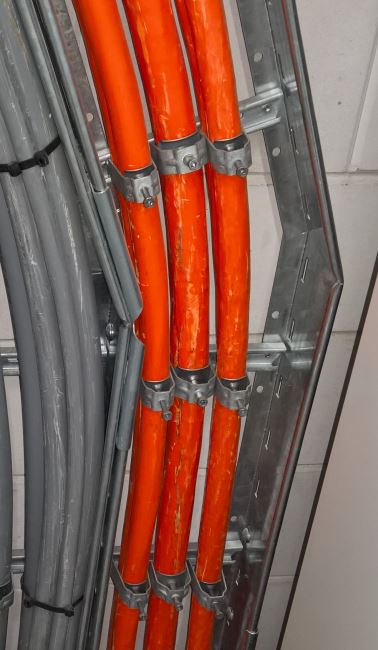
Cables for functional preservation must be able to continue to perform their function during a fire.
Requirements for fireproofing are included in the NEN-2575 and the NPR-2576 and must comply with DIN-4102 and EN-50200. In the cable database some cable types for cables with function retention are included.
With regard to the high temperature, the voltage drop and short circuit length can be specified in Kabel++.
Cables for functional preservation are often orange and are preferably laid in a separate cable duct or at least 500 mm deep in the ground. According to the Dutch standard, the color should be red.
For the indication, the fire duration is expressed in E30, E60 E90 or FB30, FB60, FB90, i.e. the latter is 90 minutes suitable for continued function. In addition, the cable should be flame-resistant (IEC 60332-3) and halogen-free(IEC-60754/IEC-61034).
Fire safety is receiving increasing attention. As of July 1, 2017, the european EN 50575 is in force and has been elaborated in a CPR for practical application. The EN-50575 gives requirements for fire behavior of cables. In the Netherlands this is incorporated in the NTA-8012. In principle, the fire resistance of each cable must be determined and included with the order.
Kabel++ includes a selection form with which you can easily determine the fire and smoke class. The selection is printed in the printout of the calculation.
Cables must be protected against short circuits. A short circuit to the casing of the device must have a safe voltage. The protection must switch off in a timely manner. The Belgian Arei knows the codes BB1 and BB2. For the BS 7671, the table 41A is applicable.
For long cables, even if the design current is low, a cable calculation will have to be made. With longer distances, the short-circuit length comes into consideration. This will be particularly important if the home automation is spread over several buildings.
For cable tray filling calculations, the purchase of the module +LK is of interest.
At frequencies higher than 50 Hz, or cross sections of 300 mm² and higher, the skin effect starts to count. Cable++ obviously takes this into account. In addition, Milliken can be set to partially negate the skin effect.
Included in Kabel++ is an option for calculating the cross-sectional area of a superconducting cable. Although the calculation is experimental, it gives an impression.
The cables are designated HTSC High Temperature Super Conducting, also referred to as HTS. The low temperature is achieved by applying a cyrogenic sheath around the conductors.
The advantage of an HTSC cable in the ground is the lack of heating of the ground and of magnetic fields due to the construction of the conductor structure. The application of superconducting cable is currently for not too long distances in crowded environments.